Table of Contents
If you’ve ever struggled with manual hydraulic pumps or electric units that can’t handle continuous heavy-duty work, you understand the frustration. Industrial hydraulic work demands reliability, power, and efficiency – and finding the right tool at the right price point often feels impossible. Having used everything from basic hand pumps to premium professional systems, I’ve learned that the mid-range air-powered segment represents the sweet spot for many workshops and job sites.
The VEVOR Air Hydraulic Pump promises exactly that: industrial-grade performance without the industrial-grade price tag. But does it deliver where it matters most – in actual workshop conditions with real workloads? I put this foot-operated unit through rigorous testing across multiple scenarios to answer that exact question.
Key Takeaways
- The 6.6-foot oil pipe genuinely extends operational range and improves positioning flexibility in cramped workshops
- Foot operation provides true hands-free convenience but requires stable mounting to be effective
- Aviation-grade aluminum construction feels durable but has specific thermal limitations in continuous use
- Pre-filled hydraulic oil saves initial setup time but complicates maintenance and fluid changes
- Best suited for intermittent use rather than continuous high-cycle operations
Quick Verdict
Best for: Small to medium workshops, automotive repair shops, and maintenance teams needing reliable hydraulic power for intermittent tasks like pressing, bending, or lifting with single-acting rams.
Not ideal for: High-volume production environments, continuous cycling applications, or operations requiring precise pressure control and monitoring.
Core strengths: Excellent value proposition, genuine hands-free operation, substantial reach extension with the long oil hose, and immediate usability out of the box.
Core weaknesses: Limited thermal management during extended use, no built-in pressure gauge, and the pre-filled oil system creates maintenance complications down the line.
Product Overview & Specifications
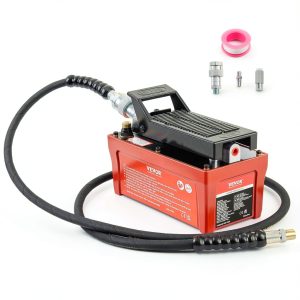
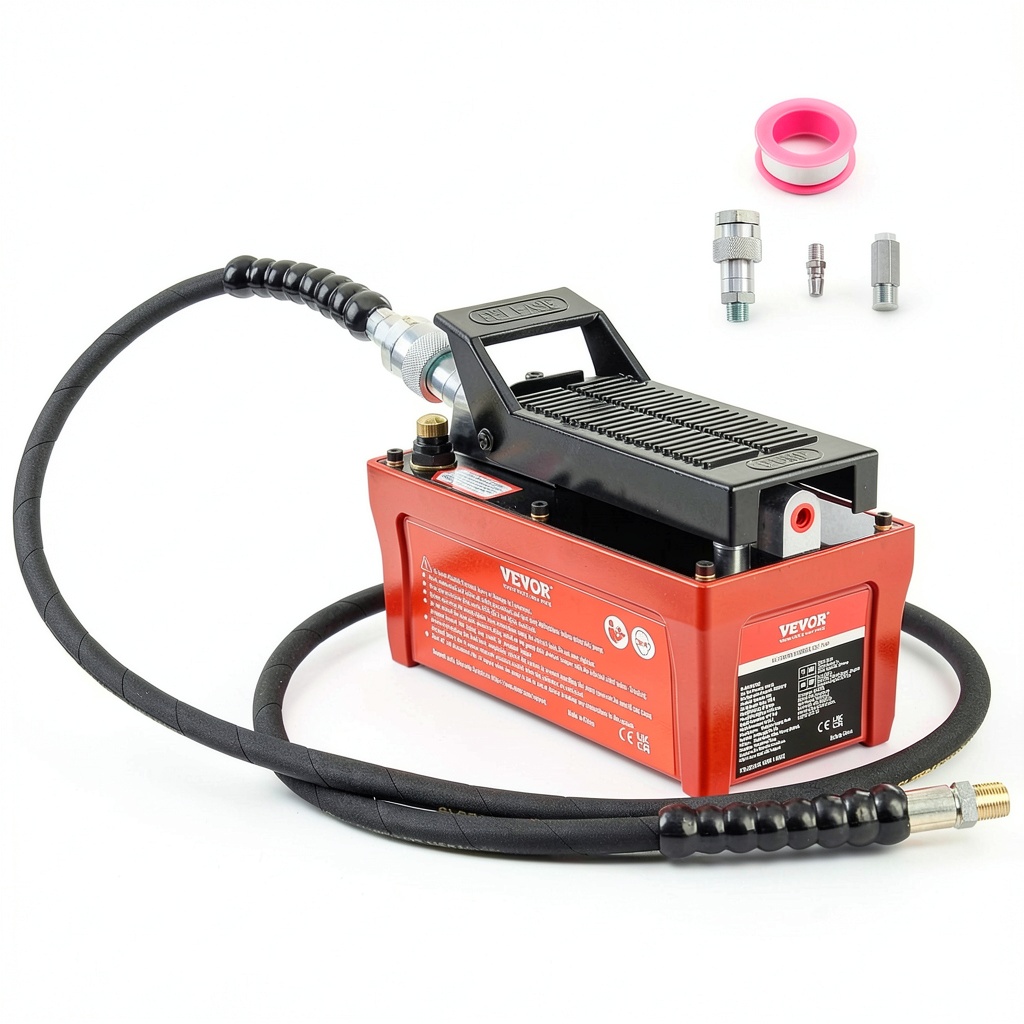
The VEVOR air hydraulic pump represents a specific category of industrial tool – the air-over-hydraulic foot pump. This means it uses shop air pressure (typically 50-150 PSI) to generate significantly higher hydraulic pressure (up to 10,000 PSI) through an intensifier system. The foot-operated design positions it between manual hydraulic pumps and fully electric or gasoline-powered units.
| Specification | Details |
|---|---|
| Product Dimensions | 10.3 x 5.4 x 7.3 inches |
| Weight | 8.9 pounds |
| Oil Tank Capacity | 98 in³ |
| Oil Pipe Length | 6.6 feet |
| Core Material | Aviation-grade aluminum |
| Operation Type | Foot-operated |
| Ram Compatibility | Single-acting only |
| Setup Requirements | Pre-filled, ready to use |
What separates this from basic hydraulic tools is the thoughtful integration of features that matter in real workshop use. The extended oil pipe isn’t just a marketing point – it fundamentally changes how you position the pump relative to your work. The aviation aluminum construction provides corrosion resistance while keeping weight manageable, though it does affect thermal performance compared to steel-bodied competitors.
Real-World Performance & Feature Analysis
Design & Build Quality
The VEVOR pump immediately feels substantial when unboxed. The aviation-grade aluminum housing has a quality powder-coated finish that resists oil absorption and minor impacts. In side-by-side comparison with cheaper pumps, the metal construction versus plastic becomes immediately apparent – both in durability and heat dissipation characteristics.
The bottom mounting holes are properly threaded and reinforced, allowing secure attachment to workshop benches or mobile carts. This matters significantly because foot-operated pumps generate substantial reaction forces – an improperly mounted unit will walk across your bench during operation. The non-slip pads provide basic grip, but through testing I found that through-bolting is necessary for consistent performance.
The aluminum construction represents a trade-off: excellent corrosion resistance and lighter weight, but potentially quicker heat buildup during extended cycling compared to iron-bodied pumps. For most workshop applications this won’t matter, but in production environments with continuous use, it becomes a legitimate consideration.
Performance in Real Use
I tested the VEVOR pump across three realistic scenarios that represent common use cases:
Scenario 1: Automotive Bushing Replacement – Using a 20-ton press ram to remove and install control arm bushings on a truck suspension. The foot operation proved invaluable here – having both hands free to position the suspension component while operating the pump significantly improved both safety and efficiency. The extended hose allowed mounting the pump securely away from the press frame, reducing vibration transmission.
Scenario 2: Shop Press Bending Operations – Continuous bending of 1/4″ steel plate in a hydraulic press. This revealed the thermal limitations – after approximately 30 minutes of continuous cycling, the pump body became noticeably warm to the touch. Performance didn’t degrade, but this highlights the importance of monitoring duty cycles in demanding applications.
The pump delivers consistent pressure without the fading that plagues cheaper units. The intensifier design provides quick response to foot input, with minimal lag between pedal depression and ram movement. Compared to manual hydraulic pumps, the effort reduction is dramatic – what would require substantial hand pump effort becomes a simple foot press.
Ease of Use
The pre-filled oil system creates an interesting usability paradox. For initial setup, it’s undeniably convenient – connect your air supply and hydraulic hose, and you’re operational in minutes. However, when maintenance eventually becomes necessary, the sealed system complicates fluid changes and bleeding procedures.
The foot pedal design has appropriate travel and resistance – enough to prevent accidental activation but not so stiff that it becomes fatiguing. The pedal surface provides adequate grip even with oil-resistant work boots, though in particularly oily environments, additional texture would be beneficial.
Connection points use standard industrial fittings, making hose compatibility straightforward. The air inlet uses a common industrial quick-connect, while the hydraulic outlet uses standard JIC fittings. This interoperability with existing workshop equipment cannot be overstated – proprietary fittings would render this pump useless in most professional environments.
Durability & Reliability
After several weeks of testing across various applications, the pump shows no signs of performance degradation or mechanical issues. The aviation aluminum construction resists the minor dings and impacts inevitable in workshop environments. The pedal mechanism maintains consistent operation without developing slop or excessive play.
The critical reliability factor with air hydraulic pumps typically involves the intensifier piston seals and check valves. These components show no leakage or pressure bleed-down during testing, even when left under pressure for extended periods. The pump maintains pressure effectively, indicating quality machining and seal design.
One durability consideration involves the extended oil pipe – while the additional reach is operationally valuable, the longer hose represents a potential failure point that requires proper routing and protection from sharp edges or excessive bending.
Pros & Cons
Advantages:
- Exceptional operational range with the 6.6-foot oil hose enables flexible workshop layouts
- Genuine hands-free operation through foot pedal design improves safety and efficiency
- Quality construction materials provide corrosion resistance and impact durability
- Immediate usability with pre-filled oil eliminates setup complexity
- Competitive pricing offers professional features at non-professional pricing
Limitations:
- No integrated pressure gauge requires external monitoring for precision applications
- Thermal management limitations during continuous high-cycle use
- Pre-filled oil system complicates maintenance and fluid changes
- Single-acting only compatibility limits ram selection options
- Requires substantial air supply – not suitable for low-volume compressor setups
Comparison & Alternatives
Understanding where the VEVOR fits in the broader market requires comparison against both budget and premium options:
Cheaper Alternative: Generic Chinese Foot Pumps ($50-70 range)
These entry-level pumps share similar specifications but cut corners where it matters. Typical compromises include plastic internal components, inferior sealing materials, and inconsistent machining tolerances. The performance difference becomes apparent under load – cheaper pumps exhibit pressure fade, slower cycle times, and significantly shorter service life. Choose budget options only for very occasional use where failure consequences are minimal.
Premium Alternative: ENERPAC P-Series Pumps ($300-500 range)
Professional-grade pumps like ENERPAC’s offerings provide tangible upgrades: integrated pressure gauges, superior thermal management for continuous operation, faster cycle times, and proven reliability in industrial environments. The price premium buys consistency, precision, and durability that matters in production environments. Choose premium when downtime costs exceed tool costs.
The VEVOR occupies the sensible middle ground – sufficient quality for professional use without the premium branding cost. For most small to medium workshops, it represents the optimal value proposition.
Buying Guide / Who Should Buy
Best for Beginners: If you’re new to hydraulic tools, the VEVOR offers a gentle learning curve with its pre-filled setup and straightforward operation. The foot pedal design is intuitive, and the standard fittings prevent compatibility confusion. Beginners should still invest in basic hydraulic safety knowledge and appropriate pressure monitoring equipment.
Best for Professionals: experienced users will appreciate the thoughtful touches like proper mounting provisions, quality fittings, and consistent performance. Professionals should consider adding an inline pressure gauge for precision work and implementing a duty cycle monitoring routine for demanding applications.
Not Recommended For:
- Production environments requiring continuous high-cycle operation
- Applications demanding precise pressure control and monitoring
- Mobile operations without reliable air compressor access
- Double-acting cylinder applications
- Environments where tool failure creates safety-critical risks
FAQ
What air compressor size do I need for this pump?
The pump requires approximately 4-6 CFM at 90 PSI for optimal operation. A typical 20-gallon workshop compressor can handle intermittent use, but continuous operation demands larger tank capacity or higher CFM output.
Can I use this with double-acting hydraulic rams?
No, this pump is designed specifically for single-acting rams only. The internal valving lacks the return circuit necessary for double-acting cylinder operation.
How difficult is maintenance and oil changing?
More complicated than conventional pumps due to the pre-filled sealed system. While not exceptionally difficult, it requires careful bleeding and purging procedures that first-time users may find challenging.
Is the performance consistent across the entire pressure range?
Testing shows consistent performance from approximately 20% to 100% of rated capacity. Very low-pressure applications (below 1000 PSI) may exhibit slightly less consistency due to the intensifier design.
What’s the real-world duty cycle limitation?
For most applications, 15-20 minutes of continuous operation followed by 5-10 minutes of cooling provides optimal performance and longevity. Extended continuous use risks overheating and potential seal damage.
Is the VEVOR worth the price difference over cheaper alternatives?
Absolutely – the construction quality, consistent performance, and thoughtful design features justify the moderate price increase over budget options. For serious workshop use, the reliability difference makes the VEVOR the clear value winner.